

Testing the water: can the EA and Thames Water turn local evidence into River Mole recovery?
River Mole River Watch has submitted our evidence into two important planning processes that went "live" recently: the Environment Agency’s Programme of Measures (PoM) and Thames Water’s Drainage Wastewater Management Plan (DWMP28). Together, these plans should show whether evidence from local groups who know the catchment is being used to shape real action for the River Mole.

River Mole River Watch met with Environment Agency catchment officers this week, alongside other members of the River Mole Catchment Partnership, Surrey Wildlife Trust and South East Rivers Trust, to submit our data as part of early work on the new EA Programme of Measures for the River Mole catchment. We have also had recent meetings with the Thames Water DWMP28 team and prepared evidence for that process, which should show how wastewater and drainage assets will be planned, upgraded and made resilient for the future. Copies of our PoM and DWMP28 submissions are linked at the end of this blog.
The Programme of Measures is meant to be the action plan behind river improvement. It sits within the wider River Basin Management Plan process and should identify the pressures stopping rivers from reaching good health, set out the measures needed to tackle them, and show who is responsible for delivery.
In practice, it should guide permits, investigations, funding, water-company investment and local catchment work.
Process | What it should do | What RMRW is looking for |
EA Programme of Measures | identify actions to improve water bodies | named measures, permits, accountability |
Thames Water DWMP28 | plan wastewater and drainage upgrades | asset schedule, capacity, delivery confidence, proof of improvement |
The PoM should answer:
What actions are needed, where, by whom, and by when, to help the River Mole and its tributaries recover?
Separately, the Thames Water DWMP28 should answer the matching question from the wastewater side:
Which sewage treatment works, pumping stations, storm overflows, sewers and drainage systems need action, when will that happen, and how will Thames Water prove that rivers are improving as a result?
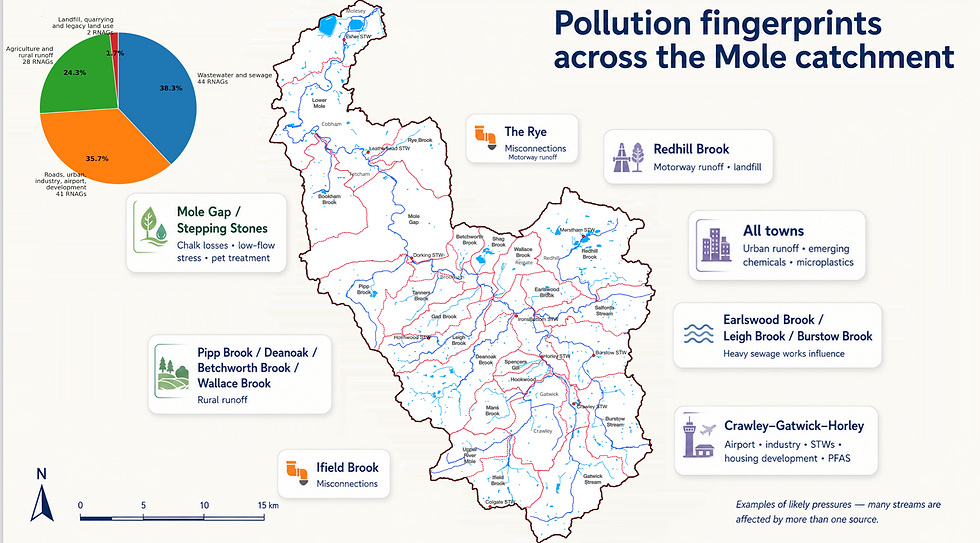
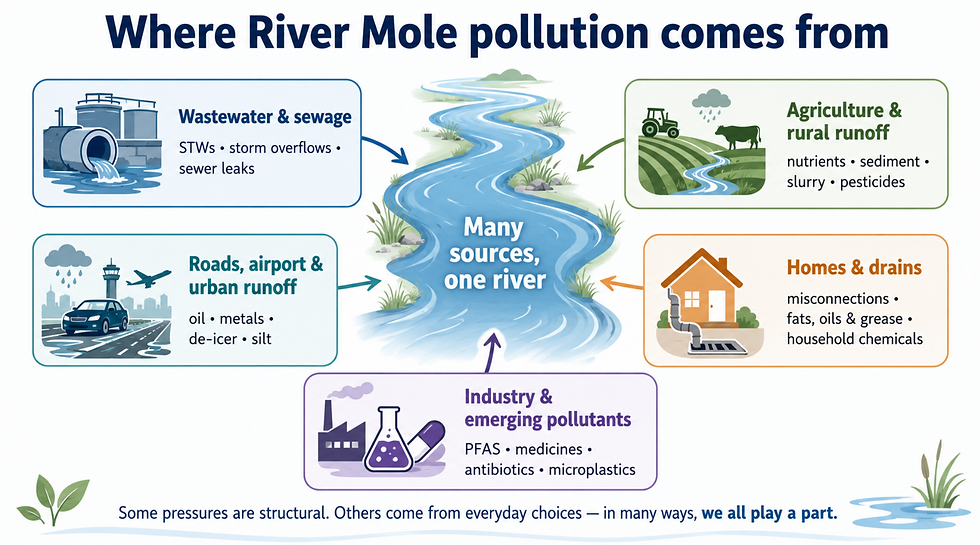
The River Mole catchment is under enormous pressure. It carries the combined impact of sewage treatment works, storm overflows, urban and industrial runoff, roads and motorways, agriculture, the airport, housing growth, public recreation, flooding, low flows and the growing effects of climate change, as well as the insidious threat from emerging chemicals.
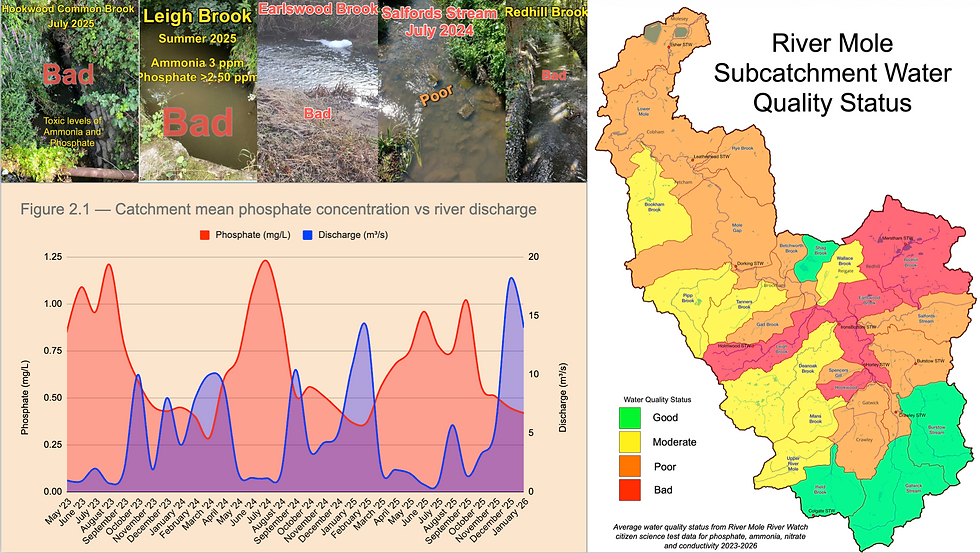
The results of our testing show most watercourses are in moderate, poor or bad condition.
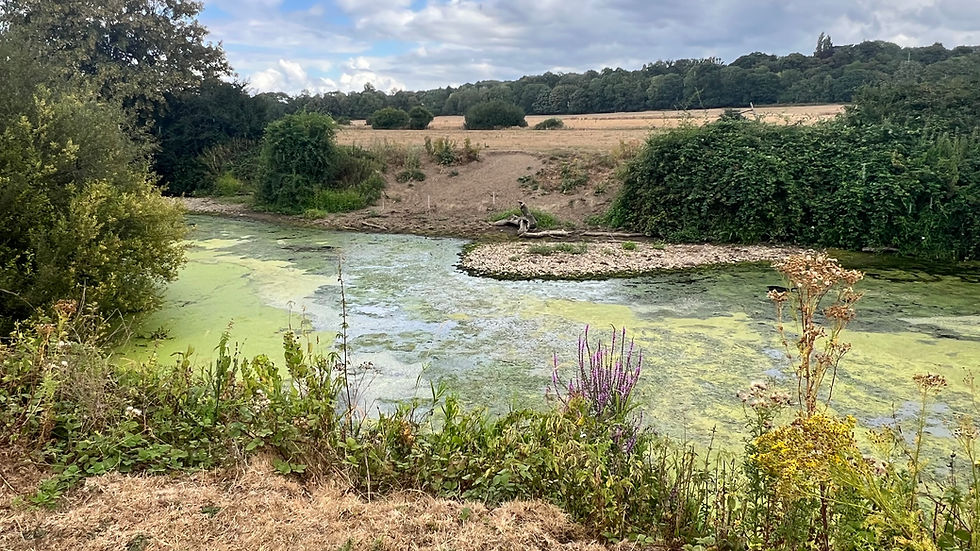
Even those in Good condition suffer surges of pollution especially in summer.

Previous River Basin Management Plans have not led to the water-quality recovery the Mole needs. Historically, this has partly been due to a lack of effective EA regulatory action combined with Thames Water’s longstanding poor wastewater performance. These have prevented real water-quality recovery across much of the Mole catchment.
To date, the River Mole has not seen the measurable recovery it needs. Responsibility for that lies not with individual officers, but with systemic regulatory failure and lack of investment in the wastewater sector.
The citizen-science evidence we have built with our volunteers has enabled us to identify specific local pollution patterns and priorities. If they are not included in EA and Thames Water plans at this stage, key pressures risk being missed.
Why now?
The Environment Agency invited Mole catchment partners to provide evidence and suggest measures in early July. We welcome the opportunity, but the timetable is extremely tight: local groups have been asked to respond within just a few weeks, during peak holiday season, while the wider Programme of Measures process is not expected to conclude until sometime in 2027.
Our PoM submission gives the EA our current view of where action is most urgently needed based on evidence from our data. Alongside our DWMP28 evidence to Thames Water, this will create a benchmark which we can refer back to when the final plans are published.
The question will be simple:
Will the final plans reflect evidence from the river and the people who know it?
Turning evidence into action

In RMRW’s view, a useful Programme of Measures should be more than a long list of possible projects. DWMP28 should be more than a long-term asset-planning exercise.
Both PoM and DWMP28 should become practical recovery plans showing what needs to happen, where, who is responsible, and how progress will be checked.
We have particularly stressed the importance of:
specific measures for named streams and water bodies;
an urgent review of permits where discharges are damaging small streams;
proper follow-up on pollution incidents;
investment decisions that consider miles of stream improved, not just total pollutant load removed;
requiring deeper treatment of sewage discharges in summer months when river levels are low and pollutant concentrations are at their highest and most damaging;
recognition of public recreation and E. coli risk at places such as Stepping Stones, the Mole Gap and Fetcham Splash;
clear asset-level risk, capacity and delivery schedules for sewage treatment works, pumping stations, storm overflows and known network-risk locations;
verification that upgrades and incident responses produce measurable improvement downstream.
We welcome the recent positive engagement with the EA and the use of our data in identifying priority water bodies at risk of eutrophication. The next step is a stronger feedback loop with the River Mole Catchment Partnership on pollution incidents, permit concerns and public-health risks, so partners can build an accurate picture of what is improving, what remains under investigation, and where further local evidence would help.
Our immediate priorities — and why local evidence matters
The first major priority is the EA properly recognising the main River Mole channel from Horley downstream, including the Mole Gap and the Lower Mole, in the PoM. This main channel reach is not clearly represented in the current draft PoM/RNAG material, yet our monitoring shows serious and persistent pollution pressure, especially phosphate and nitrate. The Mole Gap is uniquely vulnerable because of low flows, swallow holes, chalk springs and groundwater interaction.
Linked to this, several RMRW priority catchments — including Earlswood Brook, Hookwood Common Brook, Spencers Gill, Wallace Brook and Betchworth Brook — sit within the larger official water body called Mole – Horley to Dorking. These are real local streams with real local issues, but they are invisible as separate streams in national catchment datasets.
We have identified priority tributaries where clear action, investigation or follow-up is needed. These include polluted streams affected by sewage treatment works, pumping stations, private discharges, misconnections or failing sewer networks, such as Leigh Brook, Redhill Brook, Earlswood Brook, Rye Brook, Bookham Brook, Wallace Brook and Burstow Stream.
High public-use sites such as Stepping Stones, the Mole Gap and Fetcham Splash also need proper attention because of recreation and E. coli risk.
Other priorities highlighted in our evidence include repeated seasonal pollution surges, ammonia anomalies, motorway runoff, rural land-management pressures, storm overflows, pumping stations, Gatwick-linked pressures, future housing and airport expansion, road expansion and climate change.
The full list of priority sites and measures is set out in our documents on Programme of Measures and DWMP briefing, all linked at foot of this page.
Partnership action across the catchment

The River Mole already has an active network of volunteers and partners working for its recovery. The River Mole Catchment Partnership is central to this, bringing together conservation organisations, local councils, community groups, landowners, river charities, anglers and volunteers.
River improvement will not be delivered by regulation alone. It needs local knowledge, practical restoration, monitoring, landowner engagement, better planning decisions and community pressure working together.
Across the catchment, important work is already underway. Local anglers, especially around Dorking, are involved in pond restoration, riverbank management, water-quality testing and mink trapping. South East Rivers Trust is supporting restoration work in the Gatwick Stream and Upper Mole. The Rye2Good community project in Ashtead is working with SERT and the EA to improve the Rye Brook catchment. Restore Redhill Brook is bringing together local residents, RMRW, local councillors, Surrey Wildlife Trust and Reigate Area Conservation Volunteers to improve a stretch of Redhill Brook through the town.
Natural Flood Management is also part of the picture because leaky dams slow the flow and can improve water quality. Leaky dams have been installed in the Pipp Brook catchment and near Rusper in the Upper Mole, with further nature-based NFM work planned at Oldhouse Warren in the southern watershed. RMRW is also involved in FloodMapper / FloodNav work, SuDS scrutiny, rural landowner engagement, and discussions about reedbeds, constructed wetlands and other nature-based treatment options.
Our work also connects river health with drinking-water protection. SES Water / Sutton and East Surrey Water, which supplies much of the catchment and draws heavily on groundwater from the chalk aquifer, is supporting RMRW nitrate testing in surface waters. This will help build understanding of how nitrate moves through the catchment and contribute to investigations into rising nitrate levels in some boreholes.

Gatwick Airport is another important part of the Upper Mole catchment and must be a core element of an effective PoM and DWMP28. Airport runoff, deicer risks, runway expansion plans, wastewater capacity, surface-water runoff and changes to the Gatwick Stream and Upper Mole all need to be properly considered.

The catchment also contains two busy motorways: the M23 runs along the eastern side of the catchment and the M25 cuts across the Lower Mole. Work with Storm Water Shepherds highlights the importance of high-risk road runoff outfalls, including motorway drainage that can affect vulnerable streams such as Redhill Brook and Rye Brook.

This is the kind of local detail that should be recognised in the Programme of Measures and DWMP28. But partnership action works best when it is backed by strong regulation, clear EA priorities, transparent Thames Water asset plans and measures that tackle the root causes of poor water quality.
What happens next?
RMRW will continue to share evidence with the Environment Agency, Thames Water and other partners. With our outstanding volunteers we will keep monitoring, mapping, reporting and working with others to improve the Mole and its tributaries.

Despite the very short deadline, our PoM submission creates a benchmark: a record of what local evidence is showing now, so the final EA plan can be measured against it.
Our DWMP28 evidence creates a second benchmark for Thames Water: a record of what we believe must be addressed in wastewater, drainage, asset planning, data transparency and future resilience.
The River Mole needs a practical recovery plan linking evidence, permits, pollution incidents, wastewater assets, growth, climate pressure and local restoration to named actions and transparent delivery.
When the final Programme of Measures and DWMP28 plans are published, we will compare them with what the river — and our volunteers — have already shown.
Download RMRW’s documents on EA Programme of Measures and TW DWMP28:


Comments