

River Mole Spring 2026: Fast Growing Pollution Pressure and Emerging Priorities for Action
Updated: Jun 25
May 2026: a dry spring increases pollution pressure
May 2026 completed a mostly dry, low-flow spring across the River Mole catchment. Our latest citizen science results shows pollution pressure quickly rising as rainfall fails, river flow drops and water temperatures rise. Given we are entering the second heatwave of the year already, this provides us a window into how the river might change in a warmer world.
May snapshot
The catchment average phosphate rose significantly from 0.62 mg/L in April to 0.84 mg/L in May, with 74% of tested sites falling into Poor or Bad status under our localised River Mole River Watch water-quality categories.

During the test weekend, river discharge at Leatherhead was low at 1.12 m³/s, meaning there was less water available to dilute nutrients and other pollutants.
Nitrate remained high through the main River Mole channel from Horley through the Mole Gap, while ammonia was dominated by serious localised spikes, especially at Hookwood Common Brook, conductivity remained high, and average water temperature rose sharply to over 20.4°C, which is the second highest monthly temperature recorded in our data series (highest was June last year at 21°C).
Taken together, these results show a catchment moving rapidly and earlier than usual into summer stress conditions.


After over three years of regular citizen science testing, we are seeing increasingly clear, repeated patterns that allow us to "triage" the catchment: identifying sites of special concern, sites of emerging concern, and streams that need watching.

In this blog post, we examine the most recent data from May 2026 and also explore the longer-term patterns of spring, comparing spring 2026 with past springs.
2026 another dry spring: low water, less dilution
May’s results need to be understood in the context of the weather and river flow. Spring 2026 was relatively dry across the Mole catchment, especially after the wet start to the year. Rainfall at Charlwood was around 50% of the long-term average in March, only 11% in April, and 48% in May.
This matters because the River Mole is a very flashy catchment. After rainfall, river levels rise quickly, but in dry weather they fall quickly. By the 30 May test weekend, there had been no rain for eleven days, and river discharge at Leatherhead was down to 1.12 m³/s, lower than the 1.60 m³/s recorded during May testing last year.

Low river flow does not create pollution but it does reduce dilution so concentrating contaminants. The same inputs from sewage treatment works, misconnections, private treatment systems, roads, farms, gardens and urban drainage can produce higher concentrations when there is less water in the river. While summer increasing concentration happens every year, this May shows pollution concentration rising steeply and earlier than usual.
Phosphate: May’s clear warning signal
Phosphate is the clearest warning signal in May. The catchment average rose from 0.62 mg/L in April to 0.84 mg/L in May. That is a substantial increase in one month and places the catchment average well into Poor status under our River Mole River Watch localised water-quality categories.
The spread of results is also concerning. In May, 74% of tested sites were in Poor or Bad phosphate status, and 87% were Moderate, Poor or Bad. This is the highest May proportion of Poor/Bad phosphate results in our dataset.

Leigh Brook and Hookwood Common Brook, shown in the chart below, illustrate this concerning steep rise in phosphate concentration compared with previous springs.

Phosphate is one of the most important pollutants we monitor because it drives excessive plant and algal growth and contributes to long-term ecological stress. Its chronic impact can be severe: smothering habitats, altering plant communities, reducing oxygen resilience and weakening the river’s ecology over time.
The May results show that phosphate pressure was widespread. The highest May readings included Leigh Brook at 2.51 mg/L, Hookwood Common Brook at 2.50 mg/L, Crawter’s Brook at 1.34 mg/L, Mole Gap Swanworth Br at 1.29 mg/L, Betchworth Brook at 1.19 mg/L, West Vale at 1.17 mg/L, Sidlow at 1.14 mg/L and Pipp Brook at 1.09 mg/L.

The main River Mole channel is a particular concern. Spring phosphate concentrations were especially high from Gatwick Stream Horley downstream towards the Mole Gap. Several key main-channel sites averaged above or close to Poor status through spring, with West Vale, Sidlow, Castle Mill, Stepping Stones and Mole Gap Swanworth Br all showing elevated phosphate.
There was also a marked seasonal shift. In winter 2026, the Upper Mole main-channel average was 0.37 mg/L, lower than the Lower Mole. By spring, it had risen to 0.98 mg/L, surpassing the Lower Mole. This switch to highest phosphate in the Upper Mole happens each summer. Lower Mole sites such as Cobham and the Ember downstream certainly remained elevated, but the spring and summer increase is pronounced in the Upper Mole when phosphate concentration surpasses the Lower Mole. The situation reverses in winter.

Leigh Brook remains one of the most severe phosphate hotspots in the catchment, again reaching the upper limit of the Hanna Low Range phosphate checker. Hookwood Common Brook also rose sharply, with a spring average of 2.16 mg/L, compared with 0.99 mg/L in winter.

The gap between sewage works influenced streams and non-sewage works influenced streams narrowed to its smallest this May. Several non-STW tributaries saw large increases in phosphate, including Pipp Brook, Crawter’s Brook, The Rye, Deanoak Brook, Gad Brook, Ifield Brook and Burstow Lake Lane. This suggests that low-flow concentration and local pollution sources became more visible across a wider range of streams.
At 1.09 mg/L Pipp Brook experienced its highest recorded phosphate concentration in 3 years of testing.

Treated sewage effluent remains a major phosphate pressure in the catchment, but dry weather can also reveal other sources: agricultural inputs, misconnections, private sewage treatment systems and urban runoff. May shows that when dilution falls, the phosphate signal becomes broader and sharper.
Nitrate: the main River Mole corridor signal
The May catchment average for nitrate fell slightly from 19.00 mg/L in April to 17.00 mg/L in May, but the spatial pattern remained clear: the highest nitrate concentrations were concentrated along the main River Mole channel downstream from Horley through the Mole Gap to Cobham and the Lower Mole.
The highest May nitrate result was recorded at Gatwick Stream Horley at 57.60 mg/L, followed by West Vale at 56.50 mg/L, Earlswood Brook at 53.50 mg/L, Mole Gap Swanworth Br at 39.40 mg/L, Leigh Brook at 37.60 mg/L, Stepping Stones at 36.80 mg/L, Downside Bridge Cobham at 35.00 mg/L and Lower Mole Molesey at 34.10 mg/L.

This pattern is important because nitrate behaves differently from ammonia. In sewage treatment, ammonia can be converted into nitrate through biological treatment. That means high nitrate can still indicate a strong treated-effluent signal, even where ammonia readings are low.
The seasonal data support this interpretation. In Spring 2026, nitrate remained much higher in STW-influenced streams than in streams without STWs. Smaller tributaries generally had much lower nitrate concentrations, except for clear anomalies such as Earlswood Brook and Leigh Brook both of which are heavily sewage influenced from manor treatment works upstream.

However, Spring 2026 nitrate was lower than Spring 2025, with a catchment average of 16.42 mg/L compared with 20.43 mg/L last spring. That is encouraging in one sense, but nitrate remains a persistent pressure across the main River Mole channel.

Nitrate levels vary across the catchment and fluctuate with the seasons. The highest concentrations are found where the cumulative impact of upstream sewage treatment works feed into the main channel, which peaks in concentration during the summer. Earlswood Brook is a notable exception being a tributary with extremely high nitrate levels due to its flow being primarily composed of effluent from Reigate STW.
This is why nitrate is useful because it distinguishes the main River Mole channel impacted by mostly treated-effluent from the smaller tributaries where other pollutants, such as phosphate or ammonia, may be more revealing especially after prolonged storm overflows.
Ammonia: damaging localised spikes continue
Ammonia continues to the the most localised pollution signal. The catchment average rose to 0.47 mg/L, the second-highest comparable monthly ammonia average in our dataset but this average was strongly driven by one site: Hookwood Common Brook!
Hookwood Common Brook recorded 7.43 mg/L ammonia in May. This is an extremely high result compared with neighbouring streams.

Extreme spikes in ammonia are important because ammonia can be toxic to aquatic life, particularly in warm, low-flow conditions where an increase in pH causes ammonia to convert to its more toxic form, NH3. As we enter a record breaking heatwave we should be mindful of these enhanced risks to the river.

Hookwood Common Brook is not the only ammonia concern in May. Elevated readings were also recorded at Wallace Brook at 0.96 mg/L, Crawter’s Brook at 0.67 mg/L, Bewbush Brook at 0.65 mg/L, Gad Brook at 0.64 mg/L, Upper Mole, Baldhorns at 0.53 mg/L, Deanoak Brook at 0.43 mg/L and Gatwick Strm Grattons Park at 0.40 mg/L.

The ammonia pattern is different from the nitrate pattern. Major Thames Water sewage treatment works generally appear to remove ammonia effectively, with nitrate often becoming the dominant treated-effluent signal downstream. Hookwood Common Brook is different. Its repeated ammonia spikes are associated with a permitted hospital package sewage treatment plant, and the results suggest a much more acute local pollution pressure.
This distinction is important. High nitrate can reflect treated sewage effluent that has been biologically processed. High ammonia, especially where it occurs repeatedly or at very high concentrations, is more likely to indicate incomplete treatment (including storm overflows), fresh sewage contamination, animal waste, or another local source of organic pollution.

The overall conclusion is that ammonia is not a uniform catchment-wide problem in the same way as phosphate or nitrate. It is a hotspot problem. Hookwood Common Brook remains the clearest ammonia site of special concern, but May also showed that several other streams need our continued attention.
Conductivity and temperature: low-flow stress builds
Conductivity and temperature help us understand the wider stress on the river. They do not identify a single pollutant source on their own, but they are useful supporting signals. Conductivity shows the amount of dissolved ions in the water, while temperature affects oxygen levels, biological activity and the vulnerability of aquatic life to dissolved oxygen crashes and toxic ammonia.
In May, average conductivity across the catchment rose to 677 µS/cm, up from 649 µS/cm in April. This was one of the highest catchment averages in our dataset and is consistent with the low-flow pattern seen across the spring. When river flow falls, dissolved substances become less diluted, and conductivity often rises.

The highest May conductivity readings were found at familiar sites: Earlswood Brook at 960 µS/cm, Gatwick Stream Horley at 955 µS/cm, Redhill Brook at 918 µS/cm, West Vale at 917 µS/cm, Sidlow and Upper Mole, Baldhorns both at 902 µS/cm, and The Rye at 889 µS/cm. These repeated high readings suggest that conductivity has a fairly consistent spatial pattern across the catchment.

Temperature showed an even sharper change. Average water temperature rose from 13.46°C in April to 20.37°C in May, a rise of nearly 7°C in one month.
May 2026 was the second-warmest monthly average in our dataset, only just behind June 2025.
This matters because warm water holds less oxygen than cold water. Higher temperatures can also speed up biological processes, increase stress on fish and invertebrates, and make pollution incidents more damaging. Warm, low-flow conditions are therefore a risky combination, especially in streams already affected by nutrients, organic pollution or low oxygen resilience.

Conductivity and temperature reinforce the main message from May: the catchment was moving quickly into summer stress conditions. Low flow, high dissolved-ion signals and warm water all make the river less resilient to pollution.
Spring 2026 in context: what changed and what stayed the same
Monthly results are useful, but the real value of long-term monitoring is that it allows us to see seasonal patterns. Spring 2026 was not just a single poor month. It showed how quickly water-quality pressure can return when rainfall fails, river flow drops and temperatures rise.
Overall, for phosphate, Spring 2026 was similar to Spring 2025. The catchment spring average was 0.66 mg/L in both years, and higher than Spring 2024. This shows that phosphate pressure has remained persistent across recent springs, especially in the main River Mole channel and in key tributaries such as Leigh Brook and Hookwood Common Brook.

The strongest seasonal shift this year was seen in the Upper Mole main channel. In winter 2026, the Upper Mole average phosphate concentration was 0.37 mg/L. In spring, it rose to 0.98 mg/L. That is a striking change and shows how strongly this part of the river responds when dilution falls.
Several tributaries also rose sharply from winter to spring, including Gad Brook, Man’s Brook, Crawter’s Brook, Pipp Brook and The Rye. This matters because it shows smaller tributaries were also impacted by rising phosphate.
Nitrate showed a slightly different seasonal pattern. Spring 2026 nitrate averaged 16.42 mg/L, lower than Spring 2025 at 20.43 mg/L, but still high across the main River Mole corridor. The clearest nitrate signal remains the corridor of highest nitrate from Horley downstream, with Earlswood Brook standing out as the major tributary anomaly.
Conductivity also shows a repeatable pattern. The same sites that were high in Spring 2025 were generally high again in Spring 2026. This suggests that conductivity has a stable spatial fingerprint across the catchment, reflecting site-specific influences such as geology, treated effluent, urban drainage, misconnections and other dissolved-ion sources. It also suggests our kit, methods and sampling procedures carried out by our volunteers are robust.

Spring 2026 is another high-pressure spring, with persistent phosphate stress, continuing nitrate pressure through the main river channel, repeated conductivity hotspots, and rising temperature as summer approached.
The seasonal picture helps us move beyond monthly snapshots. It shows which problems are recurring, which are linked to low flow, and which sites deserve closer attention as we move into summer.
From monitoring to action: triaging the catchment
One of the most important things our long-term monitoring is now giving us is the ability to separate one-off spikes from chronic patterns. This matters because the River Mole catchment is complex. Different streams have different pressures, different sources, different geology and different seasonal behaviour. I call it a "fingerprint"...each stream has a unique set of factors and behaviour with regard to water quality.

With over three years of regular testing, we can now confidently triage the catchment. Some sites show persistent and serious pollution signals..these are sites of concern. Some show emerging concerns that need further investigation. Others remain on our watch list because the data suggest problems upstream, but the source is not yet clear.
Sites of concern
Hookwood Common Brook continues to show acute ammonia spikes, with May’s result of 7.43 mg/L the most serious example yet. This is a very different signal from most of the catchment and remains one of our highest priorities.

Leigh Brook remains one of the most phosphate-impacted streams we monitor. Its May phosphate result again reached 2.51 mg/L, the upper limit of the Hanna Low Range phosphate checker. This is consistent with a long-running severe phosphate problem in a small stream heavily influenced by treated effluent from Holmwood sewage treatment works.
Redhill Brook remains a serious concern because of its consistently poor pollution signal, especially phosphate. This is particularly important given previous claims that sewage treatment upgrades would improve the quality of treated effluent entering the stream. Our data suggest that significant water-quality pressure remains.
Earlswood Brook is different again. Its strongest signal is nitrate, reflecting its effluent-dominated flow, but it also suffered damaging ammonia spikes and sewage fungus earlier this year. It remains a key example of why permit compliance alone does not always tell us whether a small receiving stream is healthy.

Wallace Brook continues to show elevated ammonia, while The Rye at Ashtead remains notable for very high conductivity, consistent with known local pollution and misconnection concerns upstream.

Sites of Emerging Concern
A second group of streams is now emerging as a priority for closer investigation.
Betchworth Brook has repeatedly shown high phosphate for a small stream with no known Thames Water sewage treatment works outfall. Its long-term phosphate average is around 0.81 mg/L, which is high and needs better explanation.

Spencers Gill also shows persistent phosphate concern, with several properties, agricultural land-use and private sewage systems upstream.
Gatwick Stream at Horley shows persistent phosphate concerns as well as the highest nitrate test result this May indicating Poor water quality throughout this spring.
Crawter’s Brook is another emerging concern. It is a highly modified stream draining a complex urban and industrial catchment, including parts of Manor Royal and the Gatwick area. In May it recorded 1.34 mg/L phosphate and 0.67 mg/L ammonia, making it one of the more concerning results of the month.

Sites to Watch
A wider watch list includes Pipp Brook, Burstow Brook Upper Mole, Baldhorns, Tanners Brook, Bookham Brook, Man’s Brook, Deanoak Brook and Gad Brook. These are not all in the same category of concern and some even sit in WFD Good status, but some results suggest that each may have upstream pressures that need watching over time.
May also reminded us that even normally cleaner streams can produce warning signs. Bewbush Brook is usually one of the better water-quality sites in the catchment, but in May it recorded 0.65 mg/L ammonia. That may prove to be a one-off result, but it is exactly the kind of signal that regular monitoring allows us to spot and follow up.
This triage approach is becoming important to how we use our data. We cannot investigate every stream all the time. But we can use repeated, standardised monthly results to decide where concern is strongest, where new patterns are emerging, and where we need to focus future monitoring, partnership work and pressure for action.

Citizen science is helping us move to a more targeted understanding of where the problems are, how different parts of the river behave through the seasons, and which sites most urgently need attention.
Storm overflows and rainfall: too sensitive to normal rain
May’s deteriorating water-quality results were not driven by recent storm overflows. Across March, April and May 2026, storm overflows in the Mole catchment recorded only 141.30 hours of discharge, with almost all of this in March. April recorded 0.00 hours, and May recorded just 1.30 hours. These are very low durations.
This means that May’s high phosphate, nitrate, conductivity and temperature signals were mainly caused by low-flow and treated-effluent signals, rather than the result of recent storm overflow activity. In dry weather, treated effluent and other continuous inputs can make up a larger proportion of stream flow.

The longer-term overflow data tell a clear story. Storm overflow duration rises strongly with annual rainfall, which is expected to some extent. But the relationship shown is far too sensitive. The storm overflow hours vs. total rainfall correlation can be extrapolated to define the maximum predicted rainfall for zero predicted storm overflow hours. This zero overflow rainfall should be sufficiently high to indicate overflows will only occur in exceptional rainfall events. However, the trend line suggests that storm overflow duration would only fall to zero in a year with less than about 550 mm of rainfall. This is less than 70% of the lowest annual rainfall experienced in this period i.e. clearly far less than required for overflows to be restricted to abnormal rainfall events only.
The annual data suggests Thames Water storm overflows are triggered far too readily by normal rainfall and are certainly not restricted to exceptional rainfall. It suggests resilience is not yet improving in the way our rivers need.
The outliers are 2020 and 2023. 2020 had exceptionally high overflow hours.
In 2020 we are confident TW were abusing the overflow system.
They may have some excuse because of Covid which probably impacted their ability to respond due to staffing issues. 2023 was an exceptionally good year - we could look more closely at the data to understand why, e.g. was the rain spread more evenly over time with fewer high intensity, high rainfall events?
So while this spring’s low overflow total is welcome, it reflects low rainfall, not an improving or more resilient sewer network.
Conclusion: what May and Spring 2026 tell us
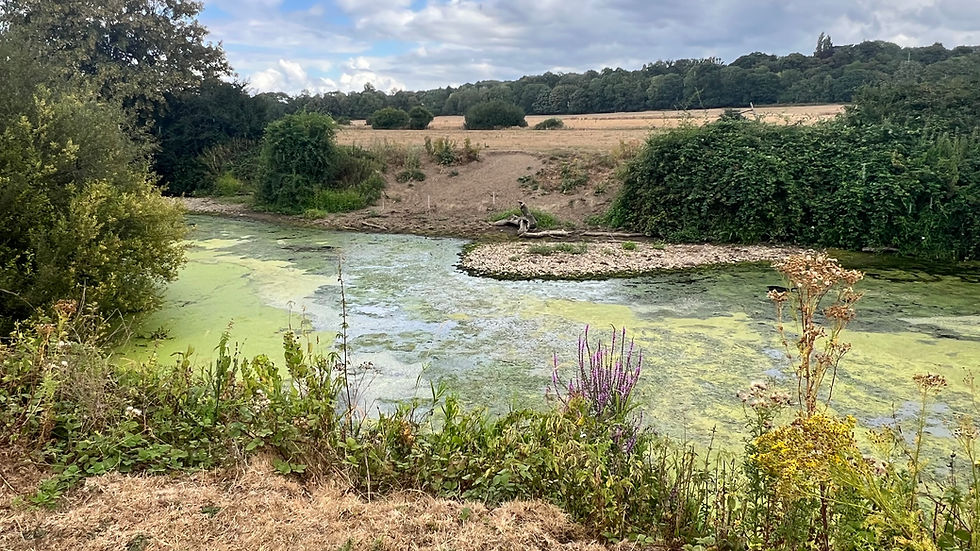
May 2026 shows how quickly pollution pressure and stress can build in the River Mole catchment when rainfall fails, river flow drops and temperatures rise. The river may look calm and attractive in dry weather, but our results show that low flow can make pollution signals sharper and ecological stress greater.
Phosphate was widespread and rose strongly in May.
Nitrate remained concentrated along the main River Mole corridor and in effluent-dominated streams.
Ammonia was more localised, and in places acute, especially at Hookwood Common Brook.
Conductivity and temperature showed the wider low-flow stress building across the catchment.
Our monitoring is now helping us move from general concern to more targeted evidence. It allows us to identify sites of special concern, emerging concerns and streams that need continued watching. That evidence can then be used in discussions with the Environment Agency, Thames Water, local councils, landowners, community groups and other partners.
As always, none of this would be possible without our volunteers. Thank you to everyone who tested, recorded, checked, mapped, analysed and shared results this month. Your work is building one of the clearest pictures available of water quality across the River Mole catchment.
Thank you so much for reading! Please like and share this update, follow River Mole River Watch, and support our work if you can.


Comments