

River Mole June 2026: low flows expose serious pollution pressure across the catchment

River Mole River Watch’s June 2026 citizen science test results show a catchment under serious stress from different causes.

Our regular testing took place over the weekend of 27-28 June after a hot, dry two weeks, with low river flows, high water temperatures and very little dilution. Following the second heatwave of the year, our phosphate data show serious pollution pressure worsening across the whole River Mole catchment.
In June 81% of sites were in Poor or Bad water quality status — the highest proportion in three years of testing.

Nitrate remained high along the main River Mole corridor, especially from Horley downstream, while ammonia spiked sharply in several concerning locations, including some normally cleaner sites.
During the test weekend there was a serious pollution incident on Rye Brook in Leatherhead, a stream already under pressure from misconnections, motorway runoff and previous sewage leaks affecting a similar stretch in the last 12 months. A large quantity of raw sewage entered the stream from the sewer network, apparently linked to a blockage. Our testing recorded exceptionally high ammoniacal nitrogen.
Other streams with ongoing or emerging pollution concerns include Hookwood Common Brook, Leigh Brook, Tanners Brook, Spencers Gill, Upper Mole at Baldhorns Brook, and the Gatwick Stream and the River Mole itself downstream of Crawley and Horley sewage treatment works (STWs).
June’s results highlight the impact of low flows, heat, chronic nutrient pollution, wastewater influence and acute local failures on an already stressed catchment.
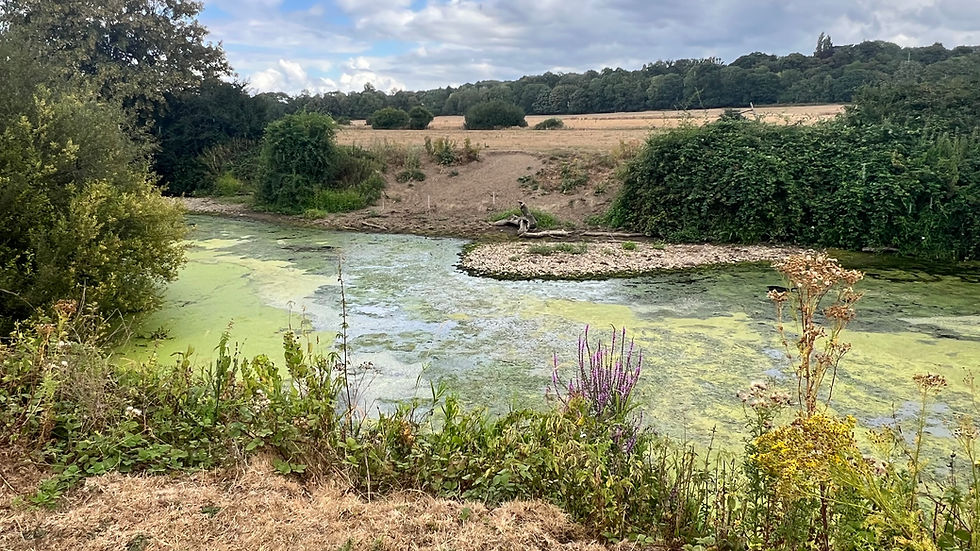
Two streams, Gad Brook and Bookham Brook, were dry and could not be sampled.
June 2026 sites of concern summary
This table summarises some of the most concerning June results. The traffic-light rating is an assessment for follow-up, not a formal classification. These are not the only polluted sites, but they show where June’s results point to the most urgent follow-up.

June weather and river-flow

June began wet, with most of the month’s rain falling in the first ten days. After that, the weather turned hot and dry, building into a heatwave. There was no effective rainfall for 16 days before testing, and air temperatures exceeded 30°C on six days immediately before the test weekend.
A band of thundery showers arrived overnight before testing, but brought only around 3 mm of rain — not enough to raise river levels. At Leatherhead, River Mole flow was just below 0.9 m³/s throughout the testing period. For context, June flow last year was 1.05 m³/s and July flow was 0.96 m³/s.
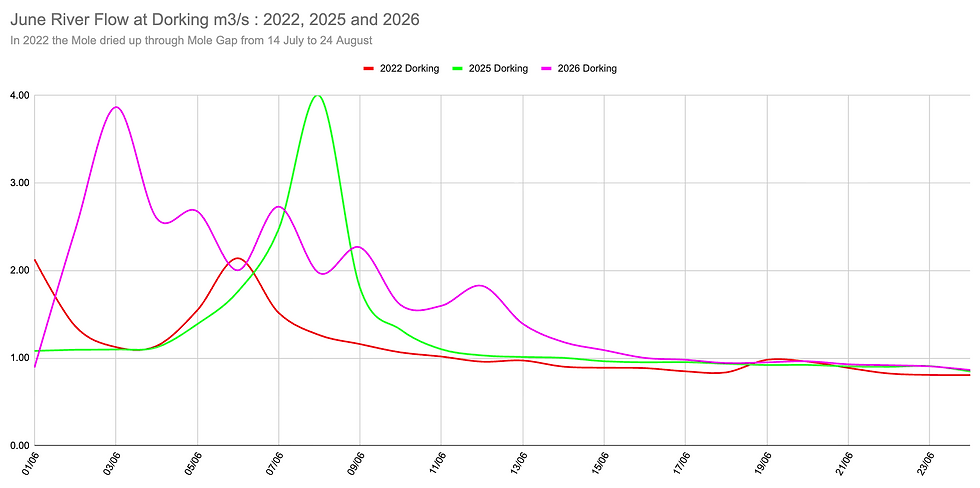

Air temperatures broke local June records, nights were also very warm, and stream temperatures rose to the highest monthly average in our dataset, at over 22°C.

Importantly, there were no storm overflows recorded in the catchment during the week before testing. This means that June results show pollution pressures during hot, dry, low-flow conditions, rather than a short-term response to recent storm overflow activity.
In short, low flow exposes pollution sources normally "hidden" due to dilution.
Phosphate: widespread catchment pressure

Rising phosphate was the clearest and most widespread pollution signal in June.
81% of measured sites were in Poor or Bad status. This is the highest proportion of Poor or Bad phosphate results we have recorded in three years of testing.

Three sites were in Bad status: Hookwood Common Brook, Leigh Brook and Rye Brook, each for quite different reasons.
In each case, phosphate was at or above the upper end of our Hanna low-range kits. Follow-up evidence confirmed very high pollution pressure at Rye Brook after the sewage incident.

A further 22 sites were in Poor status. Several were close to or above 1.00 mg/L, including Man’s Brook, Spencers Gill, Burstow Stream at Lake Lane, West Vale Bridge downstream of Horley STW, Sidlow, Mole Gap at Swanworth Farm and the Lower Mole at Ember. These are high concentrations for rivers and streams, especially during hot, low-flow conditions.

As is usually the case in summer, the main River Mole channel was consistently Poor for phosphate from Horley downstream to the Lower Mole, with the exception of Horley Riverside, which came in at Moderate status. June was unusual because phosphate pressure was not confined to tributaries hosting STWs, but was present across most of the river catchment as shown by the GIS map above.

Some of the most concerning changes were seen in the Upper Mole catchment on streams that are usually higher water quality. Bewbush Brook, one of our cleanest streams, moved from High WQ (water quality) to Moderate. Burstow Stream at Peeks Brook moved from its usual Good status to Moderate.
Ifield Brook and Upper Mole at Baldhorns Brook moved into Poor status. Redhill Brook also worsened from Moderate in May to Poor in June.

These patterns matter because these streams, except Redhill Brook, do not have major sewage treatment works. June’s phosphate results therefore point strongly towards pollution pressures that only become visible in dry weather and low flows. These pressures may include sewer leaks, misconnections, septic systems, private package treatment plants, urban drainage residues and rural land-use sources.

Nitrate: the main River Mole remains the hotspot
Nitrate followed a more familiar geographic pattern than phosphate. The June catchment average for nitrate concentration was 14.5 mg/L, but this average masks a clear split between many lower-nitrate tributaries and much higher readings along the main River Mole channel.

The highest nitrate concentrations were recorded from Horley downstream, including Gatwick Stream at Riverside, West Vale Bridge, Castle Mill Dorking, Stepping Stones, Mole Gap at Swanworth Farm, Fetcham Splash, Downside Bridge and into the Lower Mole. This shows nitrate being carried through the river system, including through the vulnerable Mole Gap.

Several tributaries also recorded high nitrate where wastewater influence is known, including Burstow Stream at Lake Lane, Earlswood Brook and Leigh Brook. Redhill Brook remained in Poor status. Many smaller tributaries away from major wastewater inputs recorded much lower nitrate. Nitrate was strongly concentrated in the main river channel and in sewage-influenced streams.
Overall, the nitrate results reinforce a consistent pattern: treated wastewater inputs are likely to add high nitrate to streams, and this carries a persistent nitrate burden far downstream along the River Mole channel.
Ammonia: serious local spikes
As usual, ammonia behaved differently from phosphate and nitrate. Most of the river system recorded low ammonia, but large local spikes in several streams showed serious pollution problems.

Ammonia spikes were so widespread this month that volunteers retested numerous locations, most turned up similar results.

Ammonia is an important indicator of acute local pollution from fresh sewage, poorly treated effluent, septic conditions or other organic pollution. It is also more directly toxic to aquatic life than phosphate or nitrate, especially in warm water.

The most toxic form is un-ionised ammonia, and the proportion present depends on water temperature and pH. Our test kits record "total" ammoniacal nitrogen, which includes both ammonia and ammonium forms. High readings, alongside our other tests and field observations, are a clear alert for increased risk of harm to aquatic life.

Hookwood Common Brook remains the most persistent concern, recording 8.00 mg/L ammonia in June. This continues the pattern of extremely high ammonia associated with the known permitted package sewage treatment plant issue at Farmfield Hospital. We are already following this up with the relevant agencies.

Several other streams are also causing concern. Tanners Brook, a rural catchment that joins the Mole in Brockham, recorded 1.61 mg/L. This is by far the highest ammonia reading recorded on this stream and a huge spike from its usual low readings around 0.10–0.20 mg/L. The Upper Mole at Baldhorns Brook recorded 1.32 mg/L, repeating a similar early-summer rise seen last year.

Spencers Gill, in Hookwood, where only residual water was present, recorded 1.25 mg/L. This rural stream has also shown summer ammonia spikes in previous years.
Two main-channel sites were also notable for high ammonia. Gatwick Stream Horley recorded 0.94 mg/L and West Vale Bridge recorded 1.43 mg/L. Ammonia is usually relatively low in the main River Mole because it is diluted and gradually transformed downstream, so these readings are highly unusual and will need watching carefully.
There were a few tentative signs of modest improvement. Crawters Brook, which drains the Manor Royal industrial estate, spiked in May but returned to a lower ammonia reading in June. Wallace Brook also remained below the worst summer spikes recorded in previous years, although it is still on our concern list because of its history of fluctuating ammonia.

The most extreme ammonia result this month was on Rye Brook following a raw sewage pollution incident. That event is serious enough to need its own section below.
Rye Brook pollution incident: raw sewage floods a vulnerable tributary

The most acute single pollution incident this month was on Rye Brook in Leatherhead, where raw sewage entered the stream from a sewer following the heatwave and immediately before our June test weekend.
[Photos in montage above courtesy L Quinnell]
The incident was first spotted when a local firm adjacent to the stream alerted Lucy Quinnell of Leatherhead and District Countryside Protection Society that the Rye Brook was running with obvious sewage pollution and a strong foul smell near the Kingston Road / Tesco / B&Q area. Lucy responded quickly, visited the site, photographed the pollution and reported it to the Environment Agency. Thames Water and the Environment Agency then attended, along with Lucy who kindly alerted River Mole River Watch.

The immediate cause appears to have been a blockage in the foul sewer network near the Kingfisher roundabout and Kingston Road bridge. The blockage was described as a mass of sewage solids, fat, wet wipes, sanitary products and other material. As the sewer backed up, foul flows appear to have been forced into an overflow or surface-water pathway discharging directly into Rye Brook.
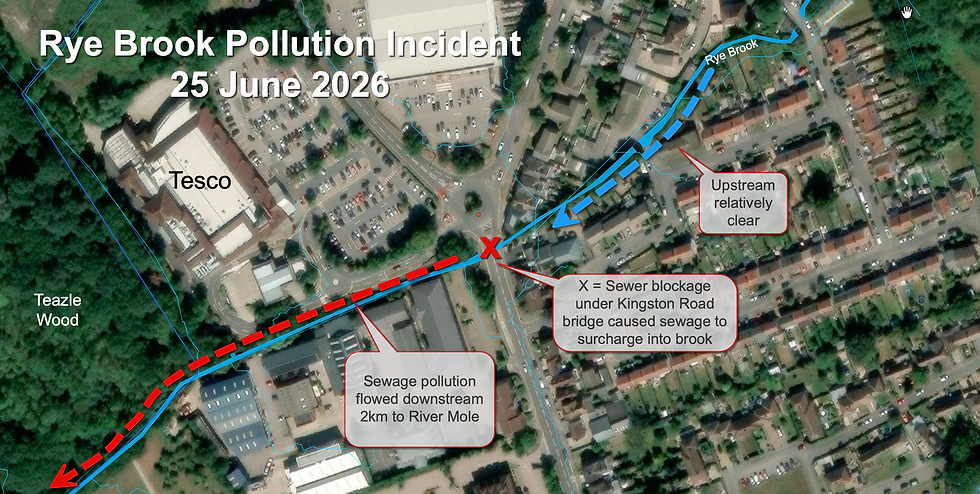
The visible impact was severe. Sewage fungus was present, the water was discoloured and foul-smelling, and pollution was evident downstream of the Kingston Road bridge as shown in the photos below taken by Nigel Bond, River Mole River Watch.
This stretch of Rye Brook flows adjacent to the Teazle Wood area and provides an important water source for local wildlife, especially during hot, dry weather. Observers reported birds, insects and mammals using the area while the stream was visibly polluted.
River Mole River Watch tested water approximately 2 km downstream from the leak. The results were extremely concerning. Phosphate was above the upper end of our normal low-range field test, with follow-up dilution testing indicating around 4.55 mg/L. Ammonia was even more alarming.
The low-range ammonia test exceeded the maximum read-out of 3.00 mg/L, and follow-up dilution testing estimated ammoniacal nitrogen at around 75 mg/L.
That is an extraordinarily high result! Ammoniacal nitrogen includes ammonia and ammonium, with the balance between the two depending on pH and temperature. Without pH, we cannot calculate the exact proportion present as un-ionised ammonia, the most toxic form. However, at this total concentration, during warm low-flow conditions, the result indicates a serious acute risk to aquatic life.

One possible explanation for the exceptionally high ammonia result, even higher than might be expected from raw sewage alone, is that low sewer flows, high temperatures and a prolonged blockage trapped sewage solids in the sewer for longer, creating septic-tank-like conditions. Under those conditions, anaerobic bacterial breakdown of organic matter can release very high levels of ammoniacal nitrogen. This is only a theory, but it is consistent with the high readings found downstream.

Thames Water cleared the blockage on 25 June and contractors returned to assess remediation. Aeration was considered, but the brook was too shallow for this to be deployed effectively without disturbing the bed. Tankers were later used to flush treated effluent through sections of the channel and polluted water was pumped out further downstream. This reduced the visible sewage burden along the stretch treated.

However, observers still reported pockets of pollution in the stream bed and are concerned that significant pollution debris remains in the stream downstream of the flushed and pumped area.
Leatherhead & District Countryside Protection Society, local businesses and residents acted quickly, kept eyes on the stream, reported the incident, photographed the pollution and helped maintain pressure for a response. River Mole River Watch supported with water-quality testing and will continue to use the results to press for investigation and action in collaboration with partners.
Rye Brook has suffered repeated sewage pollution incidents in recent years. This latest event was a serious raw sewage pollution incident in a small, vulnerable tributary already under pressure from M25 motorway runoff, urban drainage, misconnections and sewer failures. This incident shows why local vigilance, early reporting and collaborating with partners matters. With local the partners involved we will continue to press for follow-up, going beyond just emergency clean-up.
Ecoli Results

Our E.coli testing continues at Earlswood Brook, results shown above, and our exciting new weekly summer testing programme has started at the Stepping Stones (27 June : 840 cfu/100ml) and Fetcham Splash (27 June : 400 cfu/100ml), two popular places for recreation around and in the river. We will publish data as more becomes available.
What June tells us — and what happens next
June 2026 is one of the worst sets of results we have collected so far, but it may also be one of the most important.
It shows how vulnerable the River Mole catchment becomes when heat and low flows reduce dilution. The results do not point to one cause, but to several overlapping pressures: wastewater treatment, sewer network failures, private treatment systems, misconnections, urban drainage, land-use activity and rural runoff.
River Mole River Watch is already using these results to press for action: escalating serious pollution concerns, following up ammonia and phosphate spikes, asking questions of Thames Water and the Environment Agency, and identifying streams where further investigation is needed. We are involved in Thames Water’s Drainage and Wastewater Management Plan ’28 process, and our engagement with the Environment Agency is making some progress. These steps are important to resolving systemic pollution across the catchment, not only firefighting individual incidents.
A huge thank you to all our citizen science volunteers. These results only exist because our outstanding volunteers turn out to test, record, photograph and report what is happening in their adopted streams.
June’s message is clear: many of the Mole’s streams are much more vulnerable than they should be. If July and August continue dry and hot, we should be ready for even greater pressure on the river and wildlife. We call for everyone who cares about our river wildlife corridor to watch the streams and rivers closely, and report suspected pollution or visible stress to us, the Environment Agency and Thames Water.


Comments