

How We Read the Health of the River Mole
What our ammonia, nitrate and phosphate tests tell us about pollution
Rivers need nutrients, but only in the right amounts. Nitrogen, phosphorus and ammonia occur naturally in soils, plants, animals, decaying leaves and animal waste. They are also found in fertilisers, sewage, treated effluent, road and farm runoff.
Problems start when too much nutrient pollution reaches the river, especially during warm, low-flow conditions but also during prolonged storm overflows. Excess nutrients can feed algae and aquatic plants, reduce oxygen levels, and put fish, invertebrates and other river life under stress.
River Mole River Watch volunteers currently test for three key nutrients as well as conductivity and temperature:
Phosphate is often linked to sewage, fertilisers, soil runoff, septic tanks, farm runoff and animal waste. In rivers, high phosphate concentration is often a major driver of algal blooms, eutrophication and oxygen stress.
Nitrate is often linked to fertilisers, treated sewage effluent, farmland runoff and groundwater. Too much nitrate can feed excessive plant and algal growth, which may later reduce oxygen levels in the river.
Ammonia is often linked to “fresher” pollution, such as raw sewage, urine, livestock waste, poorly treated effluent and decaying organic matter. High ammonia can be harmful in its own right and can also contribute to nutrient enrichment.
River Mole River Watch citizen scientists use Hanna digital checkers to measure these nutrients. The results give us useful clues about pollution sources, nutrient pressure and how river chemistry changes downstream. Where we find acute pollution in a sub-catchment we follow-up with a focussed investigation testing at higher resolution with our partners including EA citizen science lead and SERT.

Ammonia: an early warning signal
Our Hanna low-range ammonia checkers display ammonia from 0.00 to 3.00 ppm, equivalent to 0.00 to 3.00 mg/L.
In simple terms, the checker measures the wider “ammonia family” in the river. This includes ammonia, NH₃, the more toxic form, and ammonium, NH₄⁺, the less toxic form. The Environment Agency often refers to this combined measurement as ammoniacal nitrogen.
The checker measures the total amount, but not how much is in each form. This makes it a good proxy for the risk of pollution from ammonia, rather than a direct measurement of the most toxic form alone. The EA has asked us to report all results of 2.00 mg/L and above, as these may be hazardous to river health.

A useful way to picture this is as a see-saw. On one side is the less harmful ammonium NH₄⁺; on the other is the more toxic ammonia NH₃. Warmer water and higher pH push more towards the toxic side. Cooler water and lower pH push more back towards the less harmful side. So the same ammonia reading can be more worrying on a hot summer day than in winter.
High ammonia can suggest fresher, more local pollution, such as raw sewage, animal waste, poorly treated effluent, farmyard runoff, storm overflows, misconnections, septic tank problems or decaying organic matter.
Across the River Mole catchment, most ammonia readings are very low, with a catchment average of 0.20 mg/L. However, in a few tributaries concentration goes above 2.00 mg/L and this acts as an alert for acute local pollution.
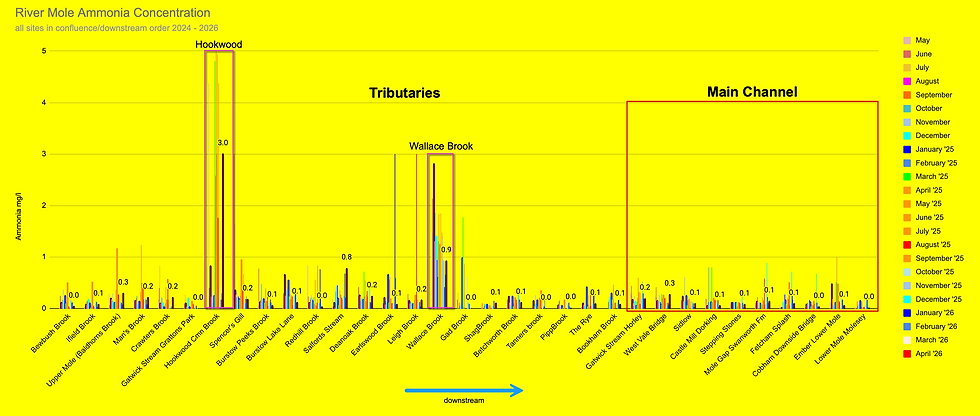
We also see ammonia concentrations generally reducing downstream along the Mole.
This is expected: ammonia can be diluted, taken up by plants and algae, or gradually processed by bacteria into other forms of nitrogen when there is enough oxygen. Our ammonia testing therefore helps us identify acute pollution incidents and where fresh pollution may be entering and how the river begins to process or dilute it.

Nitrate: tracking the river’s processed nitrogen
Our Hanna High range nitrate checker displays nitrate from 0.0 to 75.0 ppm.
In partnership with SESW, our local water supply company, RMRW uses a lab-checked adaptation of the Hanna marine checker for freshwater testing, giving a corrected range of up to 94 ppm nitrate.
Nitrate is part of the same nitrogen family as ammonia, but it behaves differently and holds different risks. Ammonia often points to fresher pollution, while nitrate is usually a more processed and longer-lasting form of nitrogen. With enough oxygen, natural bacteria can convert ammonia into nitrate, so downstream of a pollution source ammonia may fall while nitrate rises. SESW are investigating potential sources of elevated nitrate in the chalk aquifer. One source could be surface water. As the River Mole passes over chalk through the Mole Gap, nitrate rich water may pass into the chalk aquifer via swallow holes creating a risk for aquifer health. Our data is forming part of a 2-year SESW investigation into nitrate pollution in the River Mole catchment.

High nitrate concentration can indicate nutrient enrichment from fertilisers, treated sewage effluent, septic tanks or sewer inputs, groundwater, agricultural runoff, tributaries, or ammonia pollution already processed by the river. It is not immediately toxic like ammonia, but too much nitrate can feed excessive plant and algal growth, later contributing to oxygen stress. Nitrate also has strict limits in our water supply as it is not healthy especially for babies.
In the River Mole, nitrate is consistently elevated in the middle and lower main channel from Horley to Molesey. This may reflect ammonia being processed into nitrate as water moves downstream, as well as direct nitrate inputs from effluent, runoff, groundwater and tributaries. This is why ammonia and nitrate are useful together: ammonia can flag fresher pollution, while nitrate helps reveal older, more diffuse or further-processed nutrient pressure.
Phosphate: a key driver of algal and plant growth
Our Hanna Low Range phosphate checker displays phosphate from 0.00 to 2.50 ppm, equivalent to 0.00 to 2.50 mg/L.
Phosphate is a phosphorus nutrient, not a nitrogen nutrient. In small amounts it is essential for river plants and algae, but in excess it can drive eutrophication: too much growth, followed by die-back and oxygen stress.

High phosphate can come from treated sewage effluent, storm overflows, misconnections, septic tanks, fertilisers, farm runoff, soil runoff and sediment washed into the river after rain. For this reason, phosphate is one of our most important indicators of long-term nutrient pressure in the River Mole.
Our results often show phosphate peaking downstream of sewage treatment works outfalls, and also in smaller watercourses where septic tanks, misconnections, farm runoff or sediment-rich runoff may be contributing. Phosphate also tends to become more concentrated in summer low-flow conditions, when there is less dilution and warmer, slower water increases ecological stress.
Turning readings into a river story
A single Hanna reading is useful, but its real value comes from context: upstream and downstream patterns, changes after rain or during dry weather, and seasonal trends. We also consider nearby pollution pathways, such as sewage works, storm overflows, septic systems, industry and airport drainage.
Temperature, pH and oxygen are especially important for ammonia. In warm water and higher pH, more of the ammonia family shifts towards the more toxic form. During daylight, plants and algae can raise oxygen and nudge pH upwards; at night, photosynthesis stops and oxygen often falls.
This is why summer low-flow conditions can be a double whammy: less dilution, warmer water, lower oxygen resilience, and greater toxic-ammonia risk from the same reading. Higher nitrate and phosphate can add to the pressure by feeding algal growth, which may later die back and use more oxygen as it decomposes.

Our results follow these clear river-chemistry patterns. Ammonia is usually low, but tributary spikes can flag acute local pollution. Nitrate is often elevated in the Middle and Lower Mole, including through the Mole Gap. Phosphate is highest downstream of sewage-related inputs and can concentrate further during summer low flows.
Together, these readings show where pollution enters, how it changes downstream, and when river life is most vulnerable.

A note on reporting units
River Mole River Watch reports Hanna checker results in the units displayed by the equipment, because this is clear for volunteers and readers, consistent across our dataset, and suitable for tracking patterns in river health.
For phosphate, we report the Hanna Low Range Phosphate result as mg/L phosphate, PO₄. Environment Agency / WFD phosphorus standards are often expressed as phosphorus, PO₄-P, so direct comparison with those standards requires conversion. The standard conversion is:
mg/L PO₄ × 0.3261 = mg/L PO₄-P
We do not routinely apply this conversion in monthly public reports because it adds complexity and does not change the underlying patterns: hotspots, seasonal trends, upstream/downstream changes and site comparisons remain internally consistent because we use the same method and units throughout.
Where direct comparison with EA/WFD thresholds is needed, we can apply the relevant conversion. In practice, our data are already being used by partners including CaSTCo, the Environment Agency, SESW and Thames Water on the basis of our consistent Hanna results, without needing routine conversion in our public reporting.
The same principle applies to our other nutrient tests. We report the Hanna readings consistently, with the exception of our explained freshwater adaptation for the marine nitrate checker. Some formal standards may use different chemical reporting forms — for example nitrate may be expressed as nitrate or nitrate-nitrogen, and ammonia may be expressed as ammonia-nitrogen or ammoniacal nitrogen — but these are conversion issues rather than changes in the underlying result. For RMRW’s purpose of identifying pollution pressure, trends, spikes and river-health patterns, consistent reporting in Hanna units gives us clear, robust and useful evidence.
Thank you for reading this post.
Please like it and comment below and share widely.
Simon


Comments