

Extensive Sewage Fungus Growth Downstream of Reigate Sewage Treatment Works Raises Serious Concerns
A Newsflash prompted by recent observations and monitoring results, issued ahead of our next scheduled February catchment update coming soon.
More than one kilometre of Earlswood Brook is currently coated in extensive sewage fungus downstream of Reigate / Earlswood Sewage Treatment Works (STW), following a period of prolonged storm overflow activity at the site.
The growth blankets large sections of the stream bed, banks and in-channel debris in thick grey-brown mats — a well-recognised indicator of sustained organic enrichment. Sewage fungus is not a true fungus but a filamentous bacterial growth that develops where there is prolonged input of organic sewage waste, most commonly associated with wastewater discharges. While small patches can sometimes occur close to outfalls, growth at this scale does not occur in healthy streams.
The extent and density observed suggest prolonged organic loading rather than a brief pollution pulse.
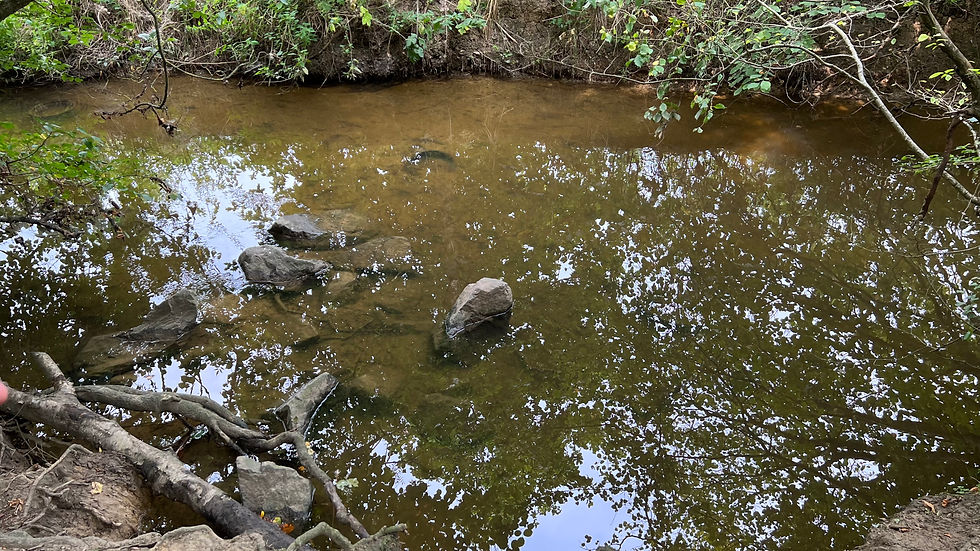
During our recent visit, no fish were seen in a reach where small shoals are usually present, particularly near the footbridge into Felland Copse. The absence of visible aquatic life alongside extensive bacterial growth is concerning. The condition of the stream contrasts markedly with photographs from healthier times in recent years shown below.
Monitoring Data and Context

On 24 January, River Mole River Watch citizen scientists recorded ammonia at 3.0 mg/L and phosphate at 1.87 mg/L in Earlswood Brook. These are very high concentrations for a small stream and were among the highest recorded anywhere in our monthly catchment monitoring that month. Sampling took place during wet weather, when dilution would normally reduce concentrations. The maps below show especially elevated ammonia and phosphate in Earlswood Brook which ranked highest in the catchment for January.
In the days immediately preceding the 24 January sampling date, Reigate / Earlswood STW recorded 74 hours of continuous storm overflow discharge — the longest uninterrupted overflow period at this works for several years.
Although January rainfall totals were elevated overall, none of the individual rainfall events exceeded a two-year return period. The conditions were wet, but not exceptional.

Other streams in the catchment, including Leigh Brook, Burstow Stream and Gatwick Stream, experienced similar recorded overflow durations during the same period but have not exhibited comparable sewage fungus growth.

This raises the possibility that factors beyond overflow duration alone may have contributed to conditions in Earlswood Brook.
One potential explanation, which can occur during sustained wet weather, is reduced treatment performance or sludge blanket disturbance within the works. We are seeking clarification on this point.
Taken together — prolonged overflow activity, a marked ammonia spike, and extensive sewage fungus growth — the sequence is consistent with sustained organic loading entering the brook from the wastewater infrastructure.
Wider Implications
We have reported our observations to both the Environment Agency and Thames Water and are seeking clarification regarding operational performance and compliance at Reigate / Earlswood STW during this period.
Even where discharges occur within permit conditions, cumulative and prolonged inputs can still result in ecological harm, particularly in small receiving streams such as Earlswood Brook.

We will continue monitoring and publish further data as it becomes available. If local residents have recent photographs or observations of changes in the brook — or notice similar issues elsewhere in the catchment — we would welcome that information.
Earlswood Brook may be modest in size, but it is an important part of the River Mole catchment and deserves the same standard of protection as any river in the system.
Thank you reading please like and share widely.


Comments